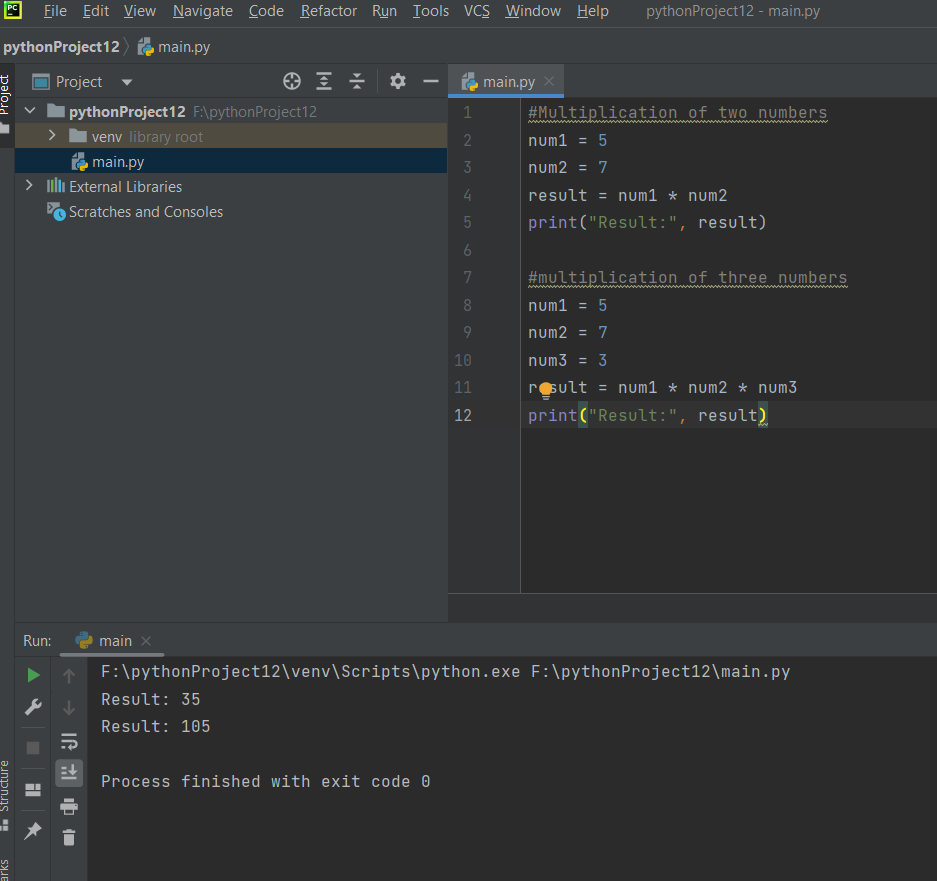
The provided Python code demonstrates how to perform multiplication of numbers using the * operator. It begins by assigning two numerical values, num1 and num2, and calculates their product, storing the result in the variable named result. The code then prints the computed result, showcasing a basic example of multiplying two numbers in Python. Additionally, a variation is shown where three numbers, num1, num2, and num3, are multiplied together, highlighting the flexibility of the multiplication operation for multiple operands. Users can easily replace the numerical values to perform multiplication with different sets of numbers, making the code adaptable for various scenarios.
Source code
#Multiplication of two numbers
num1 = 5
num2 = 7
result = num1 * num2
print("Result:", result)

#multiplication of three numbers
num1 = 5
num2 = 7
num3 = 3
result = num1 * num2 * num3
print("Result:", result)
Description
- Variable Assignment: Two variables,
num1andnum2, are assigned numerical values (5and7, respectively).
num1 = 5
num2 = 7
- Multiplication Operation: The
*operator is used to multiply the values stored innum1andnum2, and the result is assigned to a variable namedresult.
result = num1 * num2
- Print Result: The code then prints the result of the multiplication.
print(“Result:”, result)
- Extension to Three Numbers (Optional): A variation of the code is given where a third variable,
num3, is assigned a value (3) and the multiplication operation is extended to three numbers.
num3 = 3
result = num1 * num2 * num3
- Print Extended Result (Optional): The extended result is then printed.
print(“Result:”, result)
- This line outputs the result of multiplying three numbers.
The code is straightforward and serves as a basic example of how to perform multiplication in Python with one or more numbers.
Screenshot