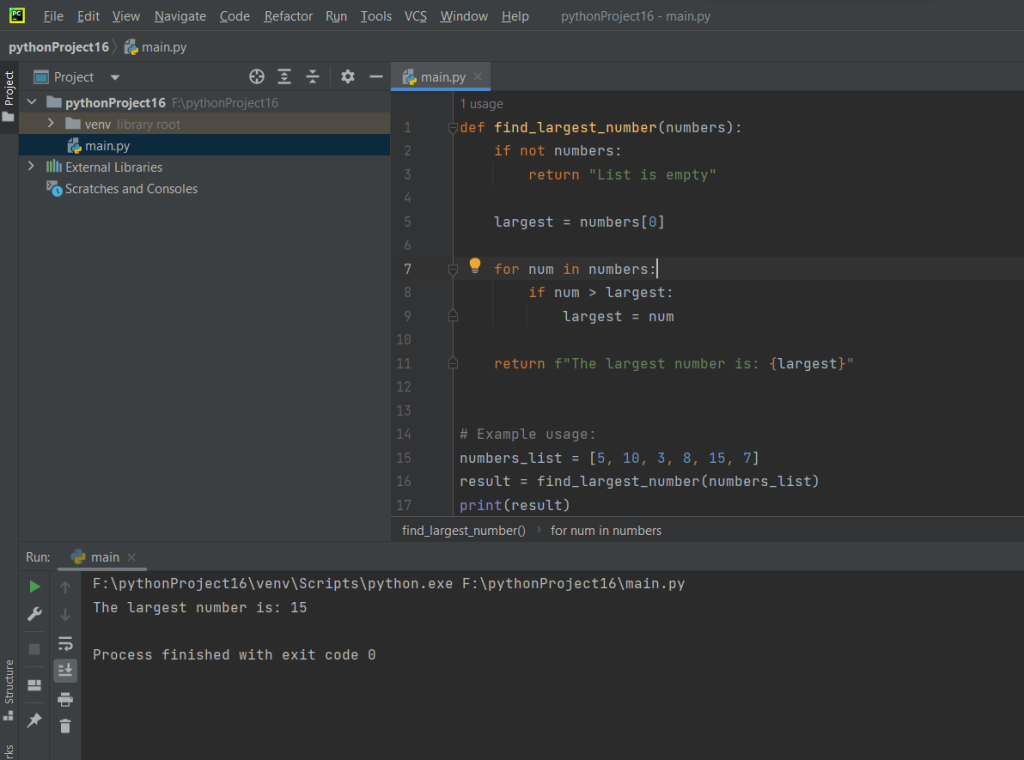
The provided Python code defines a function, find_largest_number, designed to determine the largest number within a given list of numbers. This function begins by checking if the input list is empty, returning an appropriate message if it is. Subsequently, it initializes a variable, ‘largest,’ with the first element of the list. The code then employs a loop to iterate through the list, comparing each element to the current value of ‘largest.’ If a larger number is encountered, ‘largest’ is updated accordingly. The function concludes by returning a formatted string that communicates the largest number identified in the input list. An example usage is provided, where a list of numbers, ‘numbers_list,’ is utilized as input for the function, and the result is printed. Overall, this code offers a straightforward and reusable solution for finding the largest number in a given list.
Source code
def find_largest_number(numbers):
    if not numbers:
        return "List is empty"

    largest = numbers[0]

    for num in numbers:
        if num > largest:
            largest = num

    return f"The largest number is: {largest}"


# Example usage:
numbers_list = [5, 10, 3, 8, 15, 7]
result = find_largest_number(numbers_list)
print(result)
Description
- Function Definition:
The code begins by defining a function named find_largest_number that takes a list of numbers (numbers) as an argument.
- Check for Empty List:
Within the function, there’s a conditional statement that checks if the input list is empty (if not numbers:).
- Initialization:
Inside the function, a variable named largest is initialized with the first element of the input list (largest = numbers[0]).
- Iteration through the List:
- The function uses a
forloop to iterate through each element (num) in the input list. - Within the loop, there’s an
ifstatement that compares the current element (num) with the current value oflargest. - If
numis greater thanlargest, the value oflargestis updated to be equal tonum.
- Result Formatting:
After iterating through the entire list, the function returns a formatted string using an f-string (f"The largest number is: {largest}"), indicating the largest number found in the input list.
- Example Usage:
The code provides an example usage outside the function, where a list of numbers (numbers_list = [5, 10, 3, 8, 15, 7]) is created.
- Function Call and Result Storage:
The find_largest_number function is called with the example list as an argument, and the result is stored in a variable (result).
- Print Result:
- Finally, the result is printed using the
printfunction, displaying the message “The largest number is: [value]” where[value]represents the actual largest number found in the list.
Screenshot