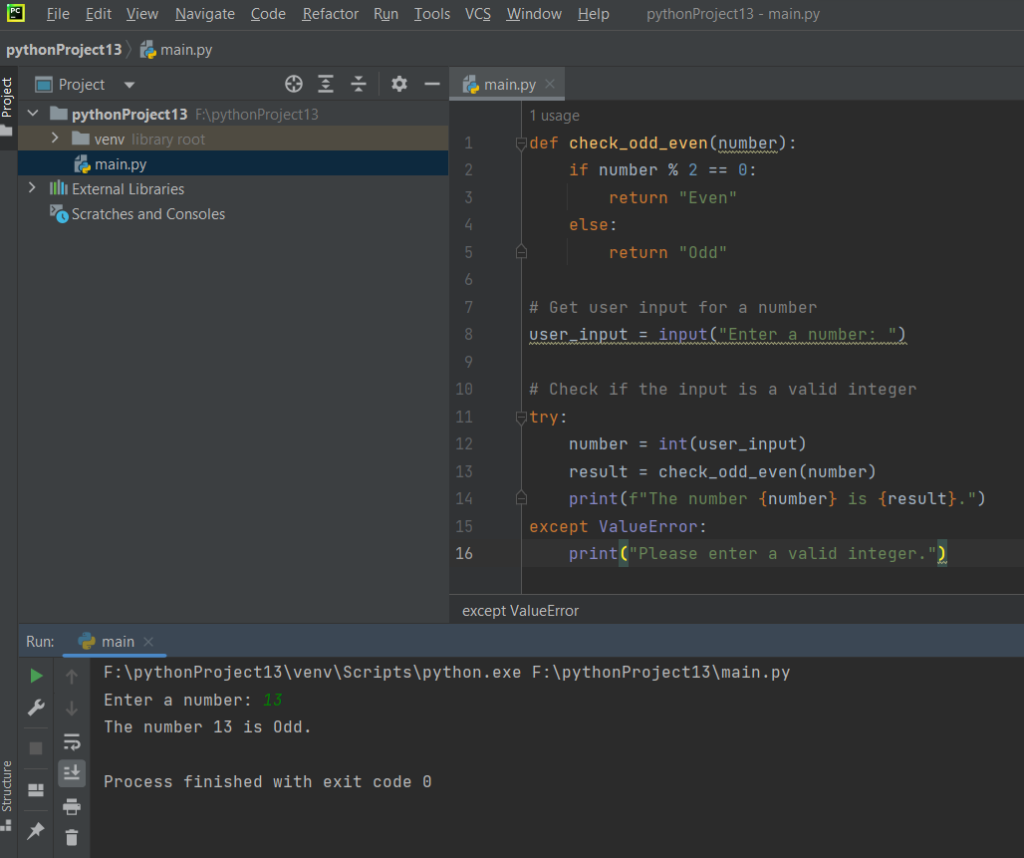
The provided Python program is designed to determine whether a given inputted number is odd or even. It defines a function, check_odd_even, which takes an integer argument and uses the modulo operator to check if the number is divisible by 2. If the remainder is zero, the function returns “Even”; otherwise, it returns “Odd.” The program then prompts the user to input a number, attempts to convert the input to an integer, and calls the check_odd_even function to obtain the result. If the user enters a valid integer, the program prints a message indicating whether the number is odd or even. In case of a non-integer input, it informs the user to enter a valid integer. Overall, the program demonstrates a basic use of functions, user input, and conditional statements in Python for determining the parity of a number.
Source code
def check_odd_even(number):
    if number % 2 == 0:
        return "Even"
    else:
        return "Odd"

# Get user input for a number
user_input = input("Enter a number: ")

# Check if the input is a valid integer
try:
    number = int(user_input)
    result = check_odd_even(number)
    print(f"The number {number} is {result}.")
except ValueError:
    print("Please enter a valid integer.")
Description
- Function Definition:
- The program begins by defining a function called
check_odd_even. - This function takes an integer argument called
number. - Inside the function, it checks if the remainder of the division of
numberby 2 is zero. - If the remainder is zero, the function returns the string “Even”; otherwise, it returns “Odd.”
- User Input:
- The program then prompts the user to input a number using the
inputfunction. - The entered value is stored in the variable
user_input.
- Input Validation:
- There is a try-except block to handle potential errors during the conversion of
user_inputto an integer. - The
int()function is used to convert the user input to an integer. - If the conversion is successful, the code inside the try block is executed; otherwise, it jumps to the except block.
- Function Invocation:
- If the input is a valid integer, the program converts the input to an integer and assigns it to the variable
number. - It then calls the
check_odd_evenfunction with the obtained number and stores the result in the variableresult.
- Output Display:
- The program prints a message indicating whether the entered number is odd or even using an f-string.
- If the user input is not a valid integer (causing an exception during conversion), the program prints a message asking the user to enter a valid integer.
- Execution:
- When you run the program, it waits for user input, performs the necessary checks and calculations, and outputs the result.
In summary, the program defines a function to check if a number is odd or even, takes user input, validates the input, and then applies the function to determine and display whether the entered number is odd or even.
Screenshot